|
|
In a message dated 9/12/2004 7:34:52 PM Central Daylight Time, 13brv3@bellsouth.net writes:
<< Would temps of 220-230 be detrimental to the engine for climb (minutes at a
time), so long as we keep oil temps below 200 for cruise (hours at a time) ?
As always thanks for your valuable information.
BTW, are you going to be able to make Tracy's fly-in next month? I, and I'm
sure others, would be willing to contribute to your airfare if you can make
it down. >>
I wish that there was a great answer for the oil temp question. The failure from over temp oil is a rotor bearing loss. Why? It has the highest stress on the bearing overlay.
The very soft gray or silver looking material on the bearing surface. The greater the distance between the hardness of the two bearing surfaces, the longer the bearing lasts. When you increase bearing hardness you increase shaft wear. The shaft is as hard as it can be made in commercial quantities. The bearings are as soft as possible and still last 150,000 miles in normal service. In the case of overly materials, most often you find bronze, copper, antimony and lead indium. Also combinations of many of these. The unfortunate common denominator is low melting temperature. I saw my uncle on my mother's side fix a spun bearing on our Ford box van (probably a 312 CU V-8) with a knife and a piece of leather belt. If you can get the oiling hole open on the throw with the spun bearing. Put a piece of wet or dry 320 paper and some oil on the crank, and saw it back and forth with a shoe lace wrapped around the crank a few turns. A piece of leather is strong enough not to deform too much, and is much softer than the crank, so it meets the criterion for a bearing. It ran that way for a few years 5 days a week. Then my mother sold it. The oil temperature gage reports the temperature of the oil that is flowing around the sensor bulb. This is spent oil that has returned to the pan from the pressure relief valve, the bearing spill and rotor cooling. The oil is picked up by the suction side of the pump and most of it gets pressurized, (where additional heat is added) and forced through a filter then a cooler(s) and then to the engine bearings and rotors for another cycle. The gage at some point samples the temperature and that should give you a very loose sloppy hint as to what is going on. So if your full throttle climb mixture is very rich to help keep things cool (say the rotors are at 375 degrees) and the bearing spill is.......????
We have no idea. If the oil is at 240, is that because we are making big power and the rotors are now over 450 degrees? We still have no data on how close to hell the bearing overlay is getting. If we could separate the bearing spill temps from the rotor cooling oil, then we could get an idea of how high we could run the oil temps and get away with it. But we don't know now. It depends on too many factors such as bearing load from torque and centrifugal force, oil film strength, flush rates of oil moving across the bearings, oil temp in the oil wedge may be 250 degrees already when the gage says 180 degrees, and it goes on.
Making 180 HP at 6,500 RPM requires more torque than the same engine making 180 HP at 7,500 RPM. (RPM X torque/5252 = HP) There is a sweet spot around 6,500 where compression and combustion pressures balance out to some small extent the centrifugal bearing loads. At 170 HP 240 degrees the bearings might last quite a long time. At 200 HP 230 degrees might reduce bearing life considerably. The oil temp reacts very fast to throttle opening. If we have a cooling problem, the driver starts shift at lower revs, and the oil temp comes right down. So if the temp goes over 190, shifting at 9,500 RPM he starts shifting at 9,300 for a lap and the temp comes back down. So the primary source of oil temp is the rotor cooling function. The bigger clearances of the racing bearings provide (a bigger hole) higher flow rate for a given volume. This aids in quickly removing heated oil from the bearing. So more pump is required to maintain the same or higher oil pressure. The stock pump has more volume than is used in normal operation, so the relief valve just leaks a little less, and set pressure is maintained.
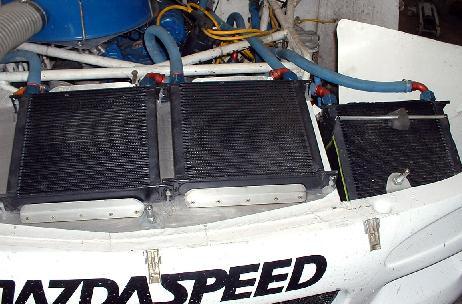
Oil temps above 160 cost HP. So says the engine builder that provides all of the Pro Mazda engines for the SCCA, Daryl Drummond. At 200 degrees you're pissing on the devil's fence. At 240 degrees you're pissing on his front door. I will visit the (Tracy's wife's) flyin someday. I have a ride in a real fast "V" tail anytime I want, so no problem there. I have a racing season to finish, and a house to rehab and sell prior to our move to Ridge Manor Florida next spring. Thank you the offer. That was really nice. The picture is of three Setrabs.
Lynn E. Hanover
Oil Radsa.jpg
|
|