Thanks Ed.
BW
From: Rotary motors in aircraft [mailto:flyrotary@lancaironline.net]
On Behalf Of Ed Anderson
Sent: Thursday, March 04, 2010
7:36 PM
To: Rotary
motors in aircraft
Subject: [FlyRotary] Re: Vance
Jaqua and Propellers
Clipping the prop in my case resulted from
several considerations.
1st
thanks to Tracy Crooks warning – my
first WOT take off (fairly short 2000 ft runway with trees at one end) with the
76x88 was only terrifying and not disastrous – thanks again for the
warning Tracy.
I found that full rudder in my RV-6A was insufficient to hold it on the
(somewhat narrow 35’ wide runway), after a hairy lift off, I found
myself drifting to the left despite full (and I do mean full) right rudder
– that left side of the runway is the side the hangars are
on(naturally). Fortunately, I had already gained sufficient altitude to
lower the right wing and adding the slip to my rudder’s yaw capability
– I managed to get it back over the runway, avoid the hangars and
make it safely into the air. Asking myself the entire time … why
didn’t I take up something like Golf, fishing, parasailing, sky jumping,
NASCA, chasing women, starting a fight in a biker’s bar,…you know -
something nice and safe{:>)
In fact, even with 2” taken off the
prop diameter, I still do not have sufficient rudder authority until around 40
mph – otherwise I have to tap the right brake to keep it aligned.
As with most things (except perhaps women) - once you become familiar
with what’s happening and develop a technique to cope with it – it
becomes manageable. So I generally ease in the throttle until I reach 40 mph or
so and then feed the rest in during take off.
So I decided I had more “torque, P
factor, wind whirl, et” than I needed or at least wanted {:>)
2nd The 76 inch prop diameter did not leave much room between the tip
of the prop and the ground – in fact less than 5” – a Tail
dragger wouldn’t have that problem. Also the dips in some grass
strips are just waiting to catch that prop with the nose gear dropping into a
small depression. Not – good. An inch more clearance
doesn’t sound like much but it can make the crucial difference. Not
a strong reason perhaps, but one I considered important.
3rd
As I indicated previously, I wanted
200 more rpm for static/take off moving me from 5800 – 6000 rpm
–6000 is such a nice round number {:>). I calculated that gave
me around 170 HP on take off. On a nice cold morning I can get over 6200
rpm on take off and fuel flow around 19 GPH.
Seems like there was one more – but,
can’t recall what it was. But all three of the above played a role
in my decision.
Those with aircraft like the RV-7A or
RV-8, tail draggers or others which stand a bit taller than the RV-6A and have
a bit more vertical fin and larger effective rudder area would probably not
elect to trim the prop from 76 to 74, but for me it was the thing to do.
Ed
From: Rotary motors in aircraft
[mailto:flyrotary@lancaironline.net] On
Behalf Of Bryan Winberry
Sent: Thursday, March 04, 2010
5:38 PM
To: Rotary
motors in aircraft
Subject: [FlyRotary] Re: Vance
Jaqua and Propellers
Veeeerrrrrry interesting indeed. I
think the key difference is, not so much the greater HP, but the greater torque
(albeit via HP) to turn that larger prop.
One thing I want to avoid is that accident
you referred to with too fine pitch. For now I have an electric MT with
auto pitch control. That should help me avoid problems like this.
I have a lot of jet time, but little prop
time. So when it comes to AOA, I think in terms of the wing producing max
lift. The AOA changes with elevator input. A prop is not unlike a
wing, but I still don’t have a grasp of what is causing AOA change in a
fixed pitch prop. But, usually I have to read things three or four times
in order to “get it”.
What gave rise to seeing a need for
clipping the larger prop? Was the torque not there? I’m sure
you answered this a few days ago, I’ll look over the old posts.
And yeah, it’s possible to overthink
this thing.
Fun nonetheless.
BW
From: Rotary motors in aircraft
[mailto:flyrotary@lancaironline.net] On
Behalf Of Ed Anderson
Sent: Thursday, March 04, 2010
4:21 PM
To: Rotary
motors in aircraft
Subject: [FlyRotary] Re: Vance
Jaqua and Propellers
You got it, Bryan, the larger prop spins
at a lower rpm – however, because it is geared to the engine with a 2:85
ratio there is less load on the engine and therefore the engine revs to a
higher rpm producing more power (and compensating some by the increase in
engine rpm). But, the prop knows nothing about the HP of the engine
– all it knows is the torque the gear box is providing it to turn.
The 2.85 provides more torque for the same engine rpm so can turn a large prop
for the same power. But, because the engine is not loaded as heavily with
the 2.85, I can get a bit more rpm –so this compensates a small bit for
the slower turning prop – because its turning a bit faster than it would
had the engine rpm remained the same as with the old prop and gear box.
The prop rpm decreased for the same
old engine rpm (but, I got a bit of that back due to the higher engine rpm with
the new gear box)– however, the larger diameter of the prop pushes more
air mass so therefore I accelerate faster on take off roll. To determine
the prop rpm simply divide engine rpm by gear box ratio – to get engine
rpm simply multiply prop rpm by gear box ratio.
With my old 68x72 I would turn around 5200-5400
on a normal day. So prop rpm was 5300 / 2.17 = 2442 rpm. With the
74x88 and 2.85 gear box, the engine would turn 6000 rpm So new prop
rpm is 6000 / 2.85 = 2105 rpm or almost 300 rpm slower. But the old prop
disc area was P(68/2)^2 = 3632 sq inches where as the new one is
P(74/2)^2 = 4300 sq inches. That gives me a 15.5% increase in disc area
with the new prop compared to a 11.6% decrease in RPM. So if everything else
were equal it would appear I would have an net 4% increase in thrust (not counting
the supposedly greater efficiency of the slower turning prop – which
might be a couple percent. But, remember this is 4% is constantly applied
during every revolution of the prop on take off. So its similar to
applying a constant acceleration to an object. Even using the very small
thrust of Ion rocket engines – they get the space craft up to tremendous
speeds because of the continuous application of that small acceleration.
So as Ernest says – there are many,
many factors involved in how a prop functions – our math calculations are
very simplified models of the real world – so don’t be surprised if
the don’t always provide the expect answer – nature really
doesn’t care about conforming to our simply models {:>)
Enough – makes my head hurt.
Ed
From: Rotary motors in aircraft
[mailto:flyrotary@lancaironline.net] On
Behalf Of Bryan Winberry
Sent: Thursday, March 04, 2010
1:49 PM
To: Rotary
motors in aircraft
Subject: [FlyRotary] Re: Vance
Jaqua and Propellers
Ed,
You’re losing me here. If I
understand you correctly, you are taking off with lower prop RPM now compared
to the original prop? But the RD-1C allows the engine to produce more HP(via
more rpm). Isn’t the goal to turn the prop just short of its’
max RPM for T/O? Come to think of it, maybe that’s your
point. Do you know the prop rpm’s for the two scenario’s?
Bryan
From: Rotary motors in aircraft
[mailto:flyrotary@lancaironline.net] On
Behalf Of Ed Anderson
Sent: Thursday, March 04, 2010
12:40 PM
To: Rotary
motors in aircraft
Subject: [FlyRotary] Vance Jaqua
and Propellers
Hi Bob, Lynn
I agree with your assessments - doesn't make any sense
otherwise.
There was a very smart individual I knew by name of Vance
Jaqua. I had several exchanges with him about propellers that made more
sense to me than what I read in Prop theory. I mean he really made sense
about props as it relates to the real and theoretical world. One of
things he pointed out regarding static thrust - was how crucial prop loading
was to thrust produced/ per horse power at/near static conditions. He
took on some of the basic tenants of current prop theory and pointed out some
thinking that just didn’t seem to make sense in the real world.
Here is an extract out of his “thinking paper” on propellers
he shared with me (my comments in
blue)
The mass that we are going to accelerate for a classic
airplane propeller, is roughly a sort of cylinder of air the size of which is
related to the diameter of the prop. (in
other words, whatever we do and however efficient it is or is not –
it’s all relative to this cylinder of air which is related to the
diameter of the prop – so the diameter of the prop appears to sort of set
a foundation element for all else)
The size of that cylinder of air controls the amount of
weight flow through the prop disk (That all important M(Mass) in our thrust and power calculations that we
discussed above). Now using that MV (momentum
= mass * velocity)formula, we can get 100 pounds force of thrust by
either accelerating 1 unit of mass by 100 feet per second, or by accelerating
100 units of mass by 1 foot per second, (or any other combination for which the
answer is 100).
However, remember the expression for power - M times
velocity squared, divided by two. This puts a big difference on how much power
we need to make the force. The 100 feet per second case computes to 5,000 ft
pounds of energy, where the 1 foot per second case is only 50 foot pounds. This
is for the static thrust case, and explains why helicopters and STOL type
airplanes use those big, rather slow turning propellers to get off the ground.
(this also helps explains why my going from a faster turning (68x72)
prop using the 2.17 gear box to a slower turning larger diameter (74x88) prop
using the 2.85 gear box increased my static thrust and take off
performance – it gave lighter disc loading)
As the airplane flies faster, the need for those large
diameters becomes less important, because now your disk is "running
into" lots of pounds per second just because of your forward
velocity.
I thought these few words of Vance explained more to me than
an entire book of theory on props.
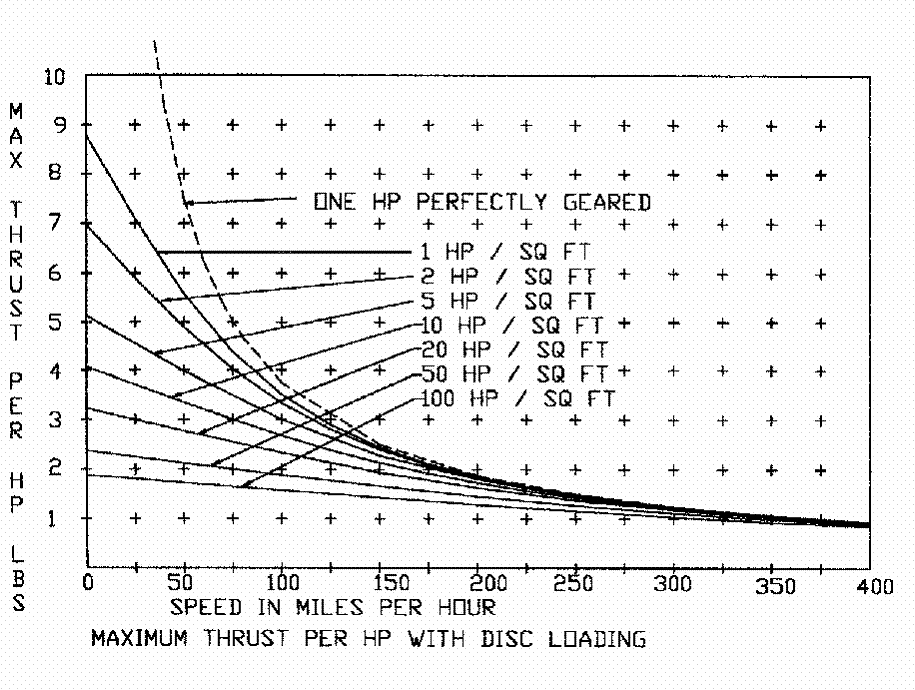
Here is a chart that Vance provided that illustrates
his point about low disc loading contributed to more static thrust.
Particularly note the difference it makes at zero airspeed (our static
condition). A very lightly loaded prop of 1 Hp /sq ft produces around 9
lbs of thrust per HP at static whereas the higher loaded (more HP per sq ft of
prop disc area) the prop is - the less static thrust produced.
This might seem counter intuitive but Vance points out a
helicopter might have a disc loading as light as 0.25 Hp/sq ft. A helicopter
can clearly produce great amounts of static thrust as it lifts its own weight
vertically off the ground at “zero” airspeed. It would appear
that greater power and smaller prop produces less thrust due to the fact that a
smaller diameter blade is likely highly pitched to absorb the greater power and
likely has a large portion of its blade stalled or otherwise turbulent,
distorted air flow as the powerful engine churns the air. Even the book
theory indicates a slower turning prop is more efficient in using power to move
air.
Unfortunately, to the best of my knowledge, Vance never
turned his notes into a finished paper. He certainly had a viewpoint that
I found understandable.
Ed
Ed Anderson
Rv-6A N494BW Rotary Powered
Matthews, NC
eanderson@carolina.rr.com
http://www.andersonee.com
http://www.dmack.net/mazda/index.html
http://www.flyrotary.com/
http://members.cox.net/rogersda/rotary/configs.htm#N494BW
http://www.rotaryaviation.com/Rotorhead%20Truth.htm
__________ Information from ESET NOD32 Antivirus, version of virus signature
database 3267 (20080714) __________
The message was checked by ESET NOD32 Antivirus.
http://www.eset.com
__________ Information from ESET NOD32 Antivirus, version of virus signature
database 3267 (20080714) __________
The message was checked by ESET NOD32 Antivirus.
http://www.eset.com
__________ Information from ESET NOD32 Antivirus, version of virus signature
database 3267 (20080714) __________
The message was checked by ESET NOD32 Antivirus.
http://www.eset.com
__________ Information from ESET NOD32 Antivirus, version of virus signature
database 3267 (20080714) __________
The message was checked by ESET NOD32 Antivirus.
http://www.eset.com
__________ Information from ESET NOD32 Antivirus, version of virus signature
database 3267 (20080714) __________
The message was checked by ESET NOD32 Antivirus.
http://www.eset.com