Well, Bill, can’t disagree that I’m
producing more HP, but the Prop doesn’t know or care about HP, it cares
about Torque. The new gear box provides the increased torque to turn the
larger prop. It’s true that if the engine was not producing more
power then there would be less torque and certainly less rpm for the
prop. So it all counts.
Look at it this way, you can have the same
engine (200HP) that can either lift a small helicopter or speed a fixed wing to
speeds of several hundred miles per hour.
The major difference is the diameter or
the prop and the prop’s rpm (gear box ratio selection) – the HP is
the same for both. That is why I say HP itself is not seen by the prop.
I agree, what you are calling
for is a controllable pitch prop – no question that would be the last
major development that would really make our rotary installations sing.
But, despite one serious attempt – nothing has yet come of it –
unless you can and want to spin some big $$ as some of our rich friends have
done as you mentioned {:>).
Since I don’t care about top speed (never
fly there except to see what it is), I knew I wanted my performance tailored
for take off out of grass strips over tall trees. My philosophy is “….
Top speed doesn’t matter if you don’t clear the trees!!! …”
. But fortunately, it actually helped my top end a few mph as well.
I certainly don’t claim nor believe
I understand props – I just go to a reliable prop manufacture and tell
told him what I had and what I wanted. When I originally got my
76x88 prop, I decided I wanted 200 more engine rpm and that is all I told Clark
Lydic and he cut off an 2” off the diameter and I got my 200 rpm
increase. Could have been just lucky, but a good prop guy can give you the
right prop – IF you give him the right information.
Ed
From: Rotary motors in aircraft
[mailto:flyrotary@lancaironline.net] On
Behalf Of Bill Bradburry
Sent: Thursday, March 04, 2010
4:26 PM
To: Rotary
motors in aircraft
Subject: [FlyRotary] Re: Vance Jaqua
and Propellers
Ed,
I think a major cause of the increased performance after you changed
the gearbox and prop was due to the fact that you were now able to get more rpm
out of the engine on takeoff and therefore were generating more horsepower.
It still seems to me that to get the most performance out of the
engine, it would have to be capable of 7500 rpm at what ever flight regime you
wanted the most performance (takeoff or cruise). I don’t think a
fixed pitch prop will allow both areas to be maximized. You have to pick
one or the other. What I assume that most of us have done is pick
somewhere in the middle that does not allow a maximum performance at either end
of the spectrum. (With the exception of some of the moneybags among us like
Mr. Steitle who has a con$tant $peed MT prop on his ES.. :>) )
I am considering(actually have decided to do it) cutting my prop down
to 74” as well. What I have been wondering about is: We lose
some performance from the prop by cutting it off, but we gain a lot in HP of
the engine due to the higher rpm and also gain from the prop due to the fact
that it is rotating much faster than it was at the longer length. Cutting
2” off the prop gives a loss of 5.2% of the cylinder of air that it is
moving. If this results in a gain of ~800 rpm, the loss is recovered and
the HP of the engine is increased considerably. I am not talking here of
static numbers, but at, say, takeoff, climb out speed and power.
I am hoping some of the folks flying with these props will chime in
with some info on what actually happens in these scenarios.
Bill B
From: Rotary motors in aircraft
[mailto:flyrotary@lancaironline.net] On
Behalf Of Ed Anderson
Sent: Thursday, March 04, 2010
12:40 PM
To: Rotary
motors in aircraft
Subject: [FlyRotary] Vance Jaqua
and Propellers
Hi Bob, Lynn
I agree with your assessments - doesn't make any sense
otherwise.
There was a very smart individual I knew by name of Vance
Jaqua. I had several exchanges with him about propellers that made more
sense to me than what I read in Prop theory. I mean he really made sense
about props as it relates to the real and theoretical world. One of
things he pointed out regarding static thrust - was how crucial prop loading
was to thrust produced/ per horse power at/near static conditions. He
took on some of the basic tenants of current prop theory and pointed out some
thinking that just didn’t seem to make sense in the real world.
Here is an extract out of his “thinking paper” on propellers
he shared with me (my comments in
blue)
The mass that we are going to accelerate for a classic
airplane propeller, is roughly a sort of cylinder of air the size of which is
related to the diameter of the prop. (in
other words, whatever we do and however efficient it is or is not –
it’s all relative to this cylinder of air which is related to the
diameter of the prop – so the diameter of the prop appears to sort of set
a foundation element for all else)
The size of that cylinder of air controls the amount of
weight flow through the prop disk (That all important M(Mass) in our thrust and power calculations that we
discussed above). Now using that MV (momentum
= mass * velocity)formula, we can get 100 pounds force of thrust by
either accelerating 1 unit of mass by 100 feet per second, or by accelerating
100 units of mass by 1 foot per second, (or any other combination for which the
answer is 100).
However, remember the expression for power - M times
velocity squared, divided by two. This puts a big difference on how much power
we need to make the force. The 100 feet per second case computes to 5,000 ft
pounds of energy, where the 1 foot per second case is only 50 foot pounds. This
is for the static thrust case, and explains why helicopters and STOL type
airplanes use those big, rather slow turning propellers to get off the ground.
(this also helps explains why my going from a faster turning (68x72)
prop using the 2.17 gear box to a slower turning larger diameter (74x88) prop
using the 2.85 gear box increased my static thrust and take off
performance – it gave lighter disc loading)
As the airplane flies faster, the need for those large
diameters becomes less important, because now your disk is "running
into" lots of pounds per second just because of your forward
velocity.
I thought these few words of Vance explained more to me than
an entire book of theory on props.
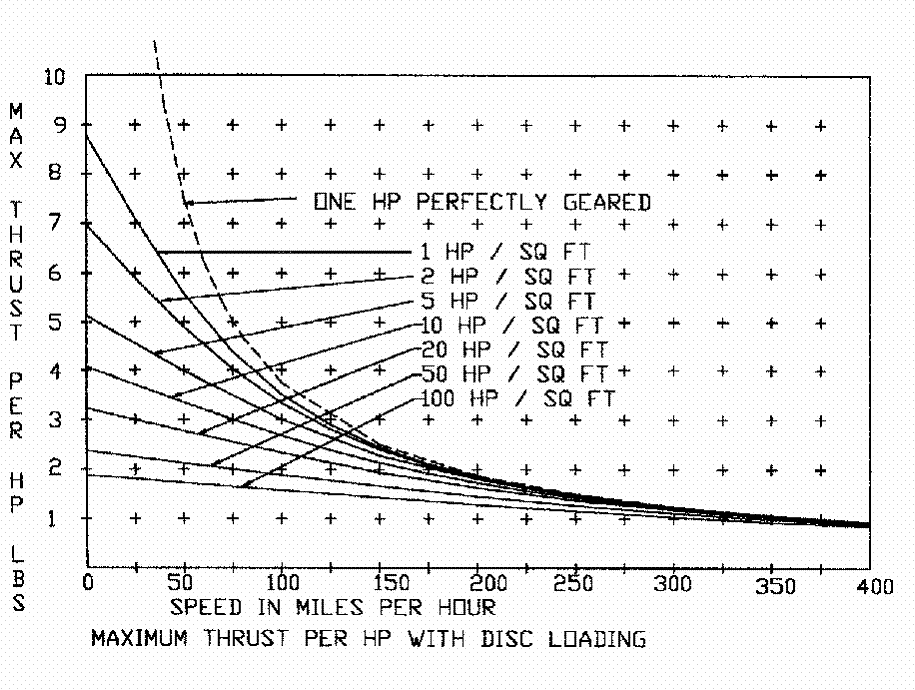
Here is a chart that Vance provided that illustrates
his point about low disc loading contributed to more static thrust.
Particularly note the difference it makes at zero airspeed (our static
condition). A very lightly loaded prop of 1 Hp /sq ft produces around 9
lbs of thrust per HP at static whereas the higher loaded (more HP per sq ft of
prop disc area) the prop is - the less static thrust produced.
This might seem counter intuitive but Vance points out a
helicopter might have a disc loading as light as 0.25 Hp/sq ft. A helicopter
can clearly produce great amounts of static thrust as it lifts its own weight
vertically off the ground at “zero” airspeed. It would appear
that greater power and smaller prop produces less thrust due to the fact that a
smaller diameter blade is likely highly pitched to absorb the greater power and
likely has a large portion of its blade stalled or otherwise turbulent,
distorted air flow as the powerful engine churns the air. Even the book
theory indicates a slower turning prop is more efficient in using power to move
air.
Unfortunately, to the best of my knowledge, Vance never
turned his notes into a finished paper. He certainly had a viewpoint that
I found understandable.
Ed
Ed Anderson
Rv-6A N494BW Rotary Powered
Matthews, NC
eanderson@carolina.rr.com
http://www.andersonee.com
http://www.dmack.net/mazda/index.html
http://www.flyrotary.com/
http://members.cox.net/rogersda/rotary/configs.htm#N494BW
http://www.rotaryaviation.com/Rotorhead%20Truth.htm
__________ Information from ESET NOD32 Antivirus, version of virus signature
database 3267 (20080714) __________
The message was checked by ESET NOD32 Antivirus.
http://www.eset.com
__________ Information from ESET NOD32 Antivirus, version of virus signature
database 3267 (20080714) __________
The message was checked by ESET NOD32 Antivirus.
http://www.eset.com