|
Bill or anyone,
I guess I need to change my question to
more specifics. For example, what do you think of the single point attachment on
the rear of the s-beam verses the more substantial attachment of the flat plate
mount. I personally don't know if I feel comfortable with a single point of
attachment in the rear. For example, there may be times when the engine
gets torqued around due to sudden changes of flight direction.
Robert
----- Original Message -----
Sent: Thursday, August 23, 2007 12:56
PM
Subject: [FlyRotary] Re: engine
mounts
Robert,
I understood the question. The fact is that either mount is attached to
the firewall with the same type of 4130 tubes. There is little difference
between the two unless you change the tube design. The response time of the
pilot, is probably the most important factor, (reducing power or shutting the
engine off), to the survival of the engine mount. The best situation here
is to do careful inspection of the prop, be it a C/S, wood, metal, or
composite. Obviously the constant speed prop is the most likely to give this
kind of problem. If you have a C/S you should be checking it carefully at
each annual. this is the ounce of prevention to prevent your pound of panic
when the blade flies off!
Bill Jepson
-----Original
Message-----
From: Rob <rob@mum.edu>
To: Rotary motors in aircraft
<flyrotary@lancaironline.net>
Sent: Thu, 23 Aug 2007 8:41
am
Subject: [FlyRotary] Re: engine mounts
If I may clarify my question a bit. My question
was not how to prevent the engine from departing but rather which mount would
survive longer because of how it is designed.
Robert
----- Original Message -----
Sent: Thursday, August 23, 2007 9:34
AM
Subject: [FlyRotary] Re: engine
mounts
Jerry,
First of all, nice looking work! Second I don't think that there is
anything wrong with either mount. The thread here started with a question
about a mount that would stay together when the prop shed a blade. This is a
problem I really think the will just leave you SOL. If you design the mount
strong enough to handle that one senario it will be overweight for
everything else!
In a message dated 8/22/2007 7:57:15 PM Pacific Standard Time, Lehanover@aol.com writes:
I would (will) go with the flat plate. All of the pan bolts are
involved. Four Lord style mounts involved.
Compact and uses the engine block for added stiffness. I will
include the nose gear in my mount to reduce fire wall complexity.
Possible oil control benefit.
Lynn E. Hanover
Lynn,
Well reasoned, but it you use a slightly changed version of the
Shertz mount like Jerry Hey is now making the mount uses the bellhousing
bolts and fits between the Psru plate and the engine. Using two large lord
mounts and that system I believe it's a toss up. I really don't think you
can really plan for this though unless you always fly high and carry a
'chute!
Bill Jepson
I have not used that design in a
long time. The S-beam now is bolted to the pan flange using
eight pan bolts at the flywheel end. It is easier to install and
does not involve the PSRU at all. I don't think there is a
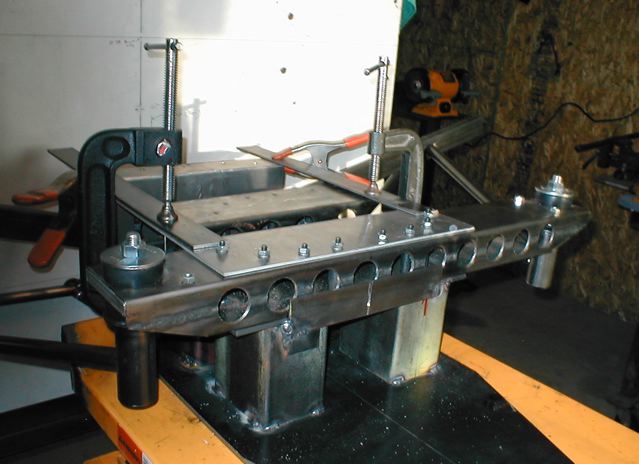
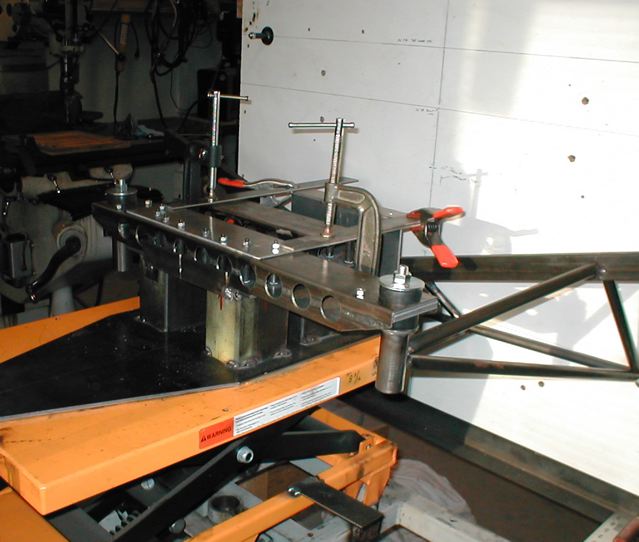
strength issue with either type of engine mount. Here are two pics
just shot this morning of a RV7A engine mount under construction. At
this stage the pan flange (less the pan) is bolted to the S-beam. The same
bolts are later used to attach the S-beam to the engine. This engine mount
is asymmetrical, it is extended on the exhaust side to provide
clearance for exhaust and is shortened on the cool side to provide room
for a cool side rad. Jerry
.  =
|