|
|
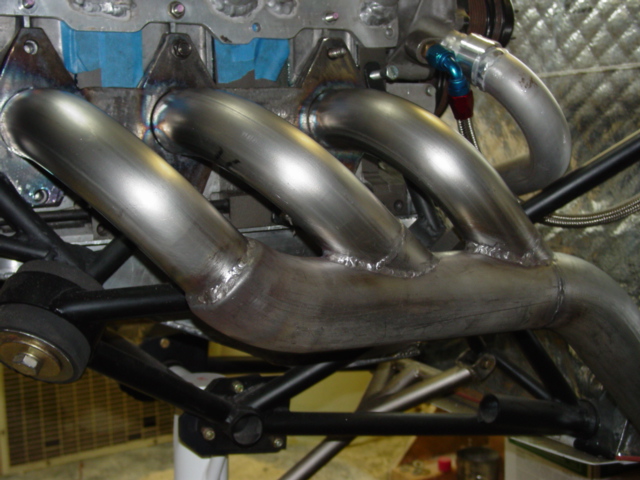
Sure looks good! Too good to change.
I don't think that the flange has much significance.
Time will tell, but you may find that the thermal stresses are where
the bends are welded to the collector.
Now, you do have fairly long bends which may absorb the
expansion. Then again, the length of the bends may make it worse.
A lot of factors here: difference of EGT of the three rotors, airflow
over the outside of the bends and collector, vibration, etc.
In any case, please keep looking for cracks in the collector where the
bends are welded to it.
If so, you'll have to at lease cut two of the bends at a straight point
(near port?) and slide pieces of tubing over the cuts. Better would be
to add actual expansion joints.
How thick is the material of the collector?
If this were a pusher, definitely safety wire the collector!
Finn
Mark R Steitle wrote:
Finn,
Maybe that’s
why some of the
aftermarket flanges are one piece. That’s how I made mine for that
very reason.
So far, so good.
Mark S.
From:
Rotary motors in aircraft
[mailto:flyrotary@lancaironline.net] On
Behalf Of Finn Lassen
Sent: Wednesday, July
26, 2006
9:37 AM
To: Rotary motors in
aircraft
Subject: [FlyRotary]
Re: Joe
Hull's OSH
Trip
- Part 2
Ground running
won't necessarily get you into that
thermo cycle range. Seems you consistently have to get above 5,000 RPM
before
anything happens.
No expansion joints: it will crack.
Unless you use ridiculously thick material. Which is probably why the
stock
Mazda manifold is so heavy.
Finn
--
Homepage:  http://www.flyrotary.com/
Archive and UnSub:   http://mail.lancaironline.net/lists/flyrotary/
|
|