|
|
In a message dated 9/12/2004 10:34:03 AM Central Daylight Time, finn.lassen@verizon.net writes:
<< Russell Duffy wrote:
> Greetings,
> > I just called Bruce to ask a few questions related to oil temp and > pressure, and I'm not sure I feel better now. > > First, he still says he wouldn't run over 210F. I was of course > hoping that he's say it was OK to run more. > > Next, I was asking about how the oil pressure regulator worked, and > got an education. While this may not be news to some of you, others > will find it as disturbing as I do. The engine has two oil > regulators. In my case, the normal regulator is set at about 75 PSI, > and is at the inlet of the oil to the engine. The other regulator is > in the front cover, to regulate oil outlet pressure, and is fixed at > 157 PSI!!! This is to allow for restriction in the oil coolers and > long lines. He said you'll see this when cold, and likely during that > first climbout, but he didn't believe it would stay that high all the > time. He did think it would always be over 100 PSI though.
> > I'm really concerned about the evap core in the current installation. > First, it just failed, as did Dave's Setrab (rated up to 232 PSI). > How many other non-Mazda oil coolers have failed? > > In my case, I have other causes for concern. My oil goes from the > engine, to the evap core, to a Peterson inline filter, back to the > engine. Along the way, I do a couple restrictive things. First, > I start at AN12, then change to AN10 at the outlet of the filter. > That probably causes some restriction, but perhaps not as much as the > oil filter itself. The Peterson filter is a stainless mesh filter, > which normally comes with a 60 micron screen. I was concerned about > that being too big, and changed to a 45 micron screen. This will > certainly be more restrictive, but the Peterson filters are very high > flow to start with, so maybe this isn't an issue. Nevertheless, I'm > concerned that I've caused enough restriction to make the oil outlet > pressure stay near it's 157 PSI limit at high RPMs. > > The next problem is not knowing what the evap core can handle. The > more I've thought about it, the more I don't think the evap core > routinely sees pressures over 90-100 PSI in the car. I also worry > that pressure pulses in gas are far more forgiving than they will be > with liquid. Who knows if there are pulses in the oil pressure that > even exceed the 232 PSI rating of the Setrab. Anyone know what the > stock Mazda coolers are rated for. > > I'm probably not going to fly again, until I have a pressure gauge on > the oil outlet of the engine, so I can read what pressure the evap > core is seeing. The VDO senders seem to skip from 150 PSI, to 350 > PSI, so there isn't a great choice. I'm even considering not flying > the evap core oil cooler again regardless. I already know it isn't > going to work well enough for my current power level, so why take a > chance. > > Has anyone checked the pressure out of the engine? What do you guys > think about all this?
> > Thanks,
> Rusty (this is why I needed another plane)
> >
The pump is capable of blowing any oil cooler up like a balloon. I have used the evaporators for years, and now use three Setrabs. Never a failure. In the evaporator years I disabled the front relief valve and ran full pump output through the evaporator then a single NAPA 5151 (APH-8A equivalent). Never a problem with the rear (sump) relief set at 90 PSI. The NAPA filter can is made by the WIX division of DANA corp. and have (if I can remember correctly) a 350 PSI burst can. I now use a pair of K&N filters on a single mount and they have a 450 PSI burst and flow close to 30 GPM at 16 microns. I think the minimum rating of the evaporators is 200PSI. Any of the shop manuals would have the recharge data on that.
There is no application on this planet for any Fram filter. None. I had two on the race car the first time I fired it up. APH-8As. One blew the can off the mount the instant the engine started. It came uncrimped from the top. Never had that happen after the change to NAPA (WIX) filters. The stock pump has shaded sections to keep noise (pressure pulses) down. I doubt that the pressure pulses are very high because of that. My current pump is a Peterson three stage external and is has one very large pressure section that really hums in operation. It does have high pressure pulses, but there have been no pressure related failures so far. (6 years of racing).
The stock pump puts out about 16 GPM at 6,000 RPM and if you take off the bug screen and add a bell shape to the end of the pickup tube, it will put out over 22 GPM with the added benefit of much less foaming. I did try a Peterson in line filter with dash 12 fittings and a 60 micron element to try to save some weight in the main pressure line. It collapsed the element at full tilt and ruined the weekend for me. But that was with the Peterson pump, not the stock pump. I think a single filter with a 40 micron element is too restrictive by a good margin. I now use two of these Peterson
"in lines" in parallel for the scavenge lines to keep debris out of the storage tank. Both have 60 micron elements and process a good amount of air along with the scavenge oil. No problems there.
There have been a large number of failures in the junction between the front iron and the front cover. There have been changes made by Mazda up to now, including adding a plastic washer around the outside of the "O" ring area and using a thicker "O" ring. None of these ideas address the problem to my thinking. On cold start up the oil can be pressurized up to 150+ pounds for a few seconds. This pressure pushes the rather flexible front cover forward and allows part of the "O" ring to escape. Very bad Mojo. Some racers run without the front gasket, in order to get more pressure on this junction.
It happens so often as to be a national tragedy. Giving the rotary an even worse undeserved black eye. If I were forced to go back to the stock pump, I would block off that junction with a thick metal disc and small "O" ring, and take pressurized oil out of the end of that same gallery. Or, install a steel sleeve to join the two passages and for get the "O" ring.
The peak oil temp of 210 should be of no concern. Not good for continuous operation.
The danger is more from overheating the bearings than from detonation in an NA engine. We run 190 on a hot day and 160-170 water temp.
Lynn E. Hanover
Picture is the Peterson inline filter cans.
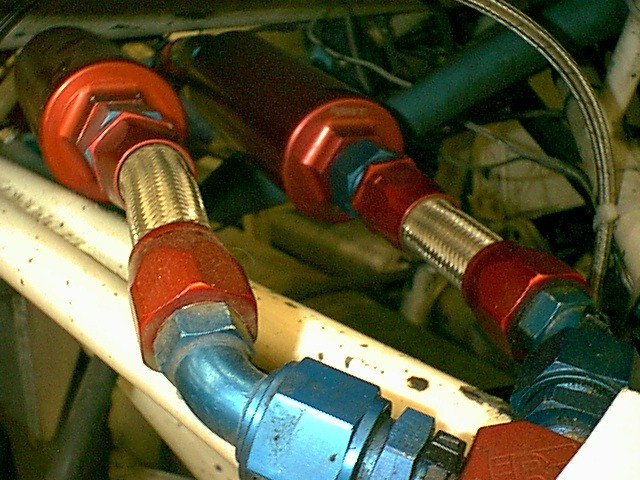
PetersonFilters.JPG
|
|